


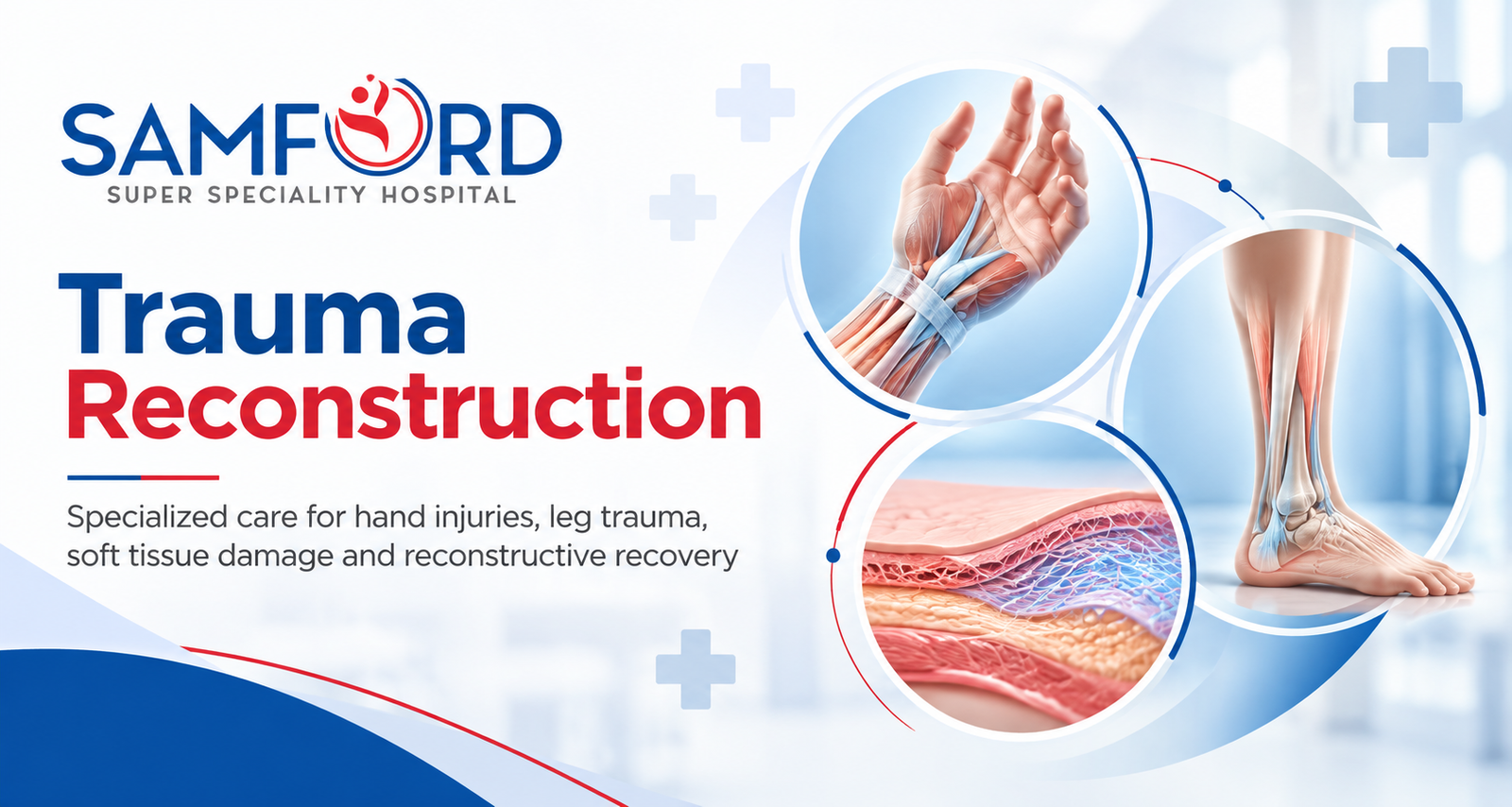
Trauma Reconstruction – Restoring Function After Serious Injuries and Soft Tissue Damage
Severe accidents and traumatic injuries can damage much more than bones. Skin, muscles, nerves, blood vessels and other soft tissues may also be affected. In such cases, Trauma Reconstruction can play an important role in restoring tissue coverage, supporting healing and improving function.
Patients with major road accident injuries, crush injuries, open wounds or tissue loss may require care from more than one medical speciality. Plastic and reconstructive surgery can become especially important when damaged tissues need repair or coverage.
Samford Burn and Plastic Surgery, located near Kokar Chowk on Hazaribagh Road, Ranchi, provides consultation for trauma-related reconstructive concerns, including hand injuries, leg injuries, soft tissue loss, scars and complex wounds.
The exact approach to Trauma Reconstruction depends on the type of injury, location, severity and structures involved.
What Is Trauma Reconstruction?
Trauma reconstruction refers to surgical and reconstructive treatment used to repair tissues damaged by accidents or other injuries.
A patient may require Trauma Reconstruction after:
- Road traffic accidents
- Industrial injuries
- Crush injuries
- Deep cuts
- Open wounds
- Hand trauma
- Leg trauma
- Soft tissue loss
- Complex scars
- Tissue defects
The main goal is usually to restore form and function while supporting wound healing.
Why Trauma Can Require Reconstruction
A serious injury can affect several tissue layers simultaneously.
For example, an accident may damage:
- Skin
- Fat
- Muscles
- Tendons
- Nerves
- Blood vessels
- Bones
When the skin and soft tissue are extensively damaged, closing the wound may not be possible without reconstruction.
This is where Trauma Reconstruction may become necessary.
Trauma Reconstruction After Road Accidents
Road traffic accidents are one of the common causes of severe trauma.
A patient may have:
- Open fractures
- Skin loss
- Deep wounds
- Exposed bone
- Muscle damage
- Nerve injury
In such situations, Trauma Reconstruction may be planned alongside Orthopaedic treatment.
Plastic and reconstructive surgery can help cover exposed tissue, repair soft tissue defects and support healing.
Hand Trauma Reconstruction
Hand injuries can be particularly complex because the hand contains multiple important structures in a small area.
These include:
- Tendons
- Nerves
- Blood vessels
- Skin
- Muscles
- Bones
Patients may require Trauma Reconstruction when a hand injury causes:
- Tissue loss
- Deep wounds
- Crush damage
- Nerve injury
- Tendon injury
- Scar contracture
The treatment plan depends on which structures are damaged.
Leg Traumas Reconstruction
Serious leg injuries may involve both bone and soft tissue.
Orthopaedic surgeons may manage fractures, while reconstructive surgery may be needed to cover wounds or exposed structures.
Traumas Reconstruction for leg injuries may involve:
- Skin grafts
- Local flaps
- Soft tissue reconstruction
- Scar revision
- Wound coverage
The goal is to protect deeper tissues and support healing.
Soft Tissue Trauma
Soft tissue trauma refers to injuries involving the skin, muscles, tendons and supporting tissues.
Examples include:
- Deep cuts
- Crush injuries
- Degloving injuries
- Machinery-related wounds
- Road accident wounds
Patients with major soft tissue injuries may require Traumas Reconstruction if primary wound closure is not possible.
What Is a Degloving Injury?
A degloving injury occurs when skin and soft tissue are separated from deeper structures.
This type of injury can be serious and may require specialist treatment.
Depending on severity, Traumas Reconstruction may involve:
- Wound cleaning
- Tissue assessment
- Skin grafting
- Flap reconstruction
- Reconstructive surgery
Early medical evaluation is important.
Skin Grafting in Traumas Reconstruction
Skin grafting may be used to cover selected wounds.
A skin graft involves transferring healthy skin from another part of the body to the injured area.
In Traumas Reconstruction, grafting may be considered when:
- A wound is too large to close directly
- Skin has been lost
- The wound bed is suitable
- Reconstruction requires surface coverage
Not every trauma wound can be treated with a skin graft.
Flap Reconstruction
Some wounds need more durable tissue coverage.
Flap reconstruction involves moving tissue while preserving its blood supply.
This can be useful when:
- Bone is exposed
- Tendons are exposed
- Important structures need coverage
- Skin grafting may not be sufficient
A specialist planning Traumas Reconstruction determines whether a flap procedure is needed.
Nerve and Tendon Injuries
Trauma may damage nerves and tendons, especially in the hands and limbs.
Symptoms can include:
- Loss of sensation
- Weakness
- Inability to move fingers or limbs
- Pain
- Reduced grip
Traumas Reconstruction may involve coordinated repair depending on the type and extent of injury.
Early evaluation can be important for functional recovery.
Complex Wound Management
Some trauma wounds are difficult to heal.
Factors may include:
- Infection
- Tissue loss
- Poor circulation
- Exposed bone
- Previous surgery
Patients with these wounds may require Trauma Reconstruction to provide stable tissue coverage.
Treatment should also address the underlying cause and infection risk.
Scar Revision After Trauma
Trauma may leave scars that are:
- Raised
- Thick
- Tight
- Painful
- Uneven
- Functionally restrictive
Patients may seek Traumas Reconstruction months after an injury if scars continue to affect movement or appearance.
Scar revision is not always required, but specialist evaluation can determine whether treatment may help.
Facial Traumas Reconstruction
Facial injuries can affect both appearance and function.
Trauma may involve:
- Skin
- Soft tissue
- Lips
- Nose
- Eyelids
- Cheeks
In selected cases, Traumas Reconstruction can help repair tissue loss, scars and post-traumatic deformity.
The treatment plan depends on the exact injury.
Multidisciplinary Care in Traumas Reconstruction
Severe trauma often requires more than one specialist.
A patient may need input from:
- Emergency Medicine
- Orthopaedics
- Plastic Surgery
- Neurosurgery
- Radiology
- Anaesthesia
- Critical Care
- Physiotherapy
This multidisciplinary approach is important because Traumas Reconstruction is often only one part of the overall treatment plan.
Why Timing Matters
The timing of reconstruction varies depending on:
- Wound condition
- Infection
- Patient stability
- Tissue damage
- Associated fractures
- Blood supply
Some procedures may be performed early, while others may need to wait until the wound is stable.
A specialist should determine the appropriate timing for Traumas Reconstruction.
Infection and Trauma Wounds
Traumatic wounds can become infected.
Warning signs may include:
- Redness
- Swelling
- Fever
- Discharge
- Pus
- Increasing pain
- Worsening wound condition
Infection may need to be controlled before definitive Trauma Reconstruction is performed.
Role of Physiotherapy
Rehabilitation is often important after severe trauma.
Patients may need physiotherapy to improve:
- Range of motion
- Muscle strength
- Joint mobility
- Hand function
- Walking ability
Trauma Reconstruction and rehabilitation often work together to improve long-term function.
Recovery After Traumas Reconstruction
Recovery depends on:
- Injury severity
- Type of reconstruction
- Location
- Associated injuries
- Patient health
- Rehabilitation
Patients may receive instructions regarding:
- Wound care
- Dressings
- Medication
- Limb positioning
- Activity restriction
- Physiotherapy
- Follow-up appointments
Recovery after Traumas Reconstruction can take time, especially after major injuries.
Possible Risks
As with any surgical procedure, reconstructive surgery can involve risks.
These may include:
- Infection
- Bleeding
- Delayed wound healing
- Scar formation
- Graft failure
- Flap-related complications
The risks depend on the type and complexity of reconstruction.
When Should You Seek Reconstructive Evaluation?
Specialist evaluation may be appropriate for:
- Large open wounds
- Tissue loss
- Exposed bone or tendon
- Severe hand injuries
- Severe leg injuries
- Crush injuries
- Complex scars
- Non-healing trauma wounds
Patients with serious injuries should seek emergency medical attention first.
Traumas Reconstruction is typically planned after the patient’s immediate medical condition is stabilized.
Traumas Reconstruction at Samford Burn and Plastic Surgery
Samford Burn and Plastic Surgery provides consultation for trauma-related reconstructive conditions, including:
- Hand trauma
- Leg trauma
- Soft tissue injuries
- Complex wounds
- Tissue defects
- Scar revision
- Post-traumatic deformity
- Reconstructive surgery
Patients looking for Trauma Reconstruction in Ranchi can contact the centre for specialist evaluation and treatment planning.
Local Trauma Reconstructions Care in Ranchi
Samford Burn and Plastic Surgery is located near Kokar Chowk on Hazaribagh Road.
Address
Samford Burn and Plastic Surgery
Hazaribagh Rd, Near Kokar Chowk
Ranchi, Jharkhand – 834001
Phone: 073600 80041
Frequently Asked Questions
What is Trauma Reconstructions?
Trauma Reconstructions refers to procedures used to repair damaged skin, soft tissue and other structures after serious injuries.
Who may need trauma reconstruction?
Patients with open wounds, tissue loss, hand or leg trauma, crush injuries or complex post-traumatic scars may require reconstructive evaluation.
Can trauma reconstruction help after road accidents?
Yes. Severe road accident injuries may require soft tissue reconstruction, wound coverage or scar correction.
Can hand trauma require reconstruction?
Yes. Hand injuries involving skin, tendons, nerves or tissue loss may require reconstructive care.
Can leg trauma require plastic surgery?
Yes. Plastic surgeons may be involved when leg injuries include soft tissue loss, exposed structures or complex wounds.
What is flap reconstruction?
Flap reconstruction uses tissue with its own blood supply to cover a wound or tissue defect.
Is skin grafting used after trauma?
Yes, selected trauma wounds may be suitable for skin grafting.
Is physiotherapy required after trauma reconstruction?
Physiotherapy may be recommended depending on the location and functional impact of the injury.
Where is Samford Burn and Plastic Surgery located?
It is located on Hazaribagh Road near Kokar Chowk, Ranchi, Jharkhand – 834001.
How can I book an appointment?
Call 073600 80041 for consultation and appointment details.
Conclusion
Serious trauma can damage skin, soft tissue, nerves, tendons and other structures in addition to bones.
Trauma Reconstruction may help restore tissue coverage, support wound healing and improve function after selected injuries.
Samford Burn and Plastic Surgery provides consultation for hand trauma, leg trauma, soft tissue injuries, complex wounds and post-traumatic reconstruction near Kokar Chowk, Ranchi.
For major accidents or severe injuries, emergency medical treatment should always be the first priority. Reconstructive treatment can then be planned according to the patient’s condition.
Samford Burn and Plastic Surgery
Hazaribagh Rd, Near Kokar Chowk
Ranchi, Jharkhand – 834001
Phone: 073600 80041