


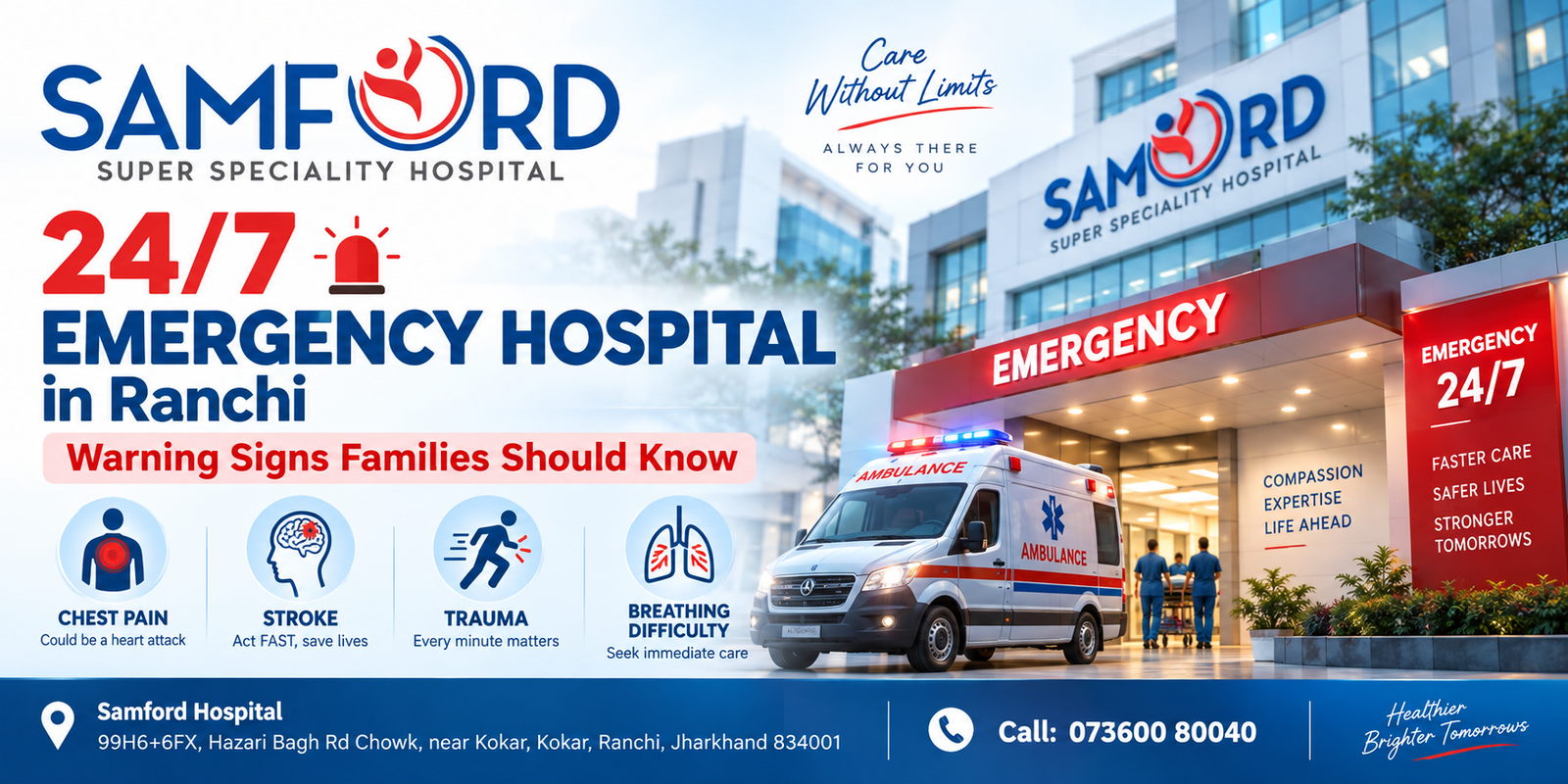
Hospital in Ranchi, 24/7 Service Hospital in Ranchi, Hospital in Ranchi, Samford Hospital Ranchi
Medical emergencies can happen at any time—at home, at work, on the road, or in the middle of the night. In such situations, recognizing serious warning signs and reaching an appropriate medical facility without unnecessary delay can be important.
Someone experiencing severe chest discomfort, sudden stroke symptoms, major trauma, significant breathing difficulty, loss of consciousness, seizures, severe bleeding, burns, poisoning, or another potentially life-threatening condition may require urgent medical evaluation.
For families searching for a 24/7 Emergency Hospital in Ranchi, it is useful to know what symptoms should not be ignored and what emergency facilities to look for.
Samford Hospital at Kokar Chowk, Ranchi, provides 24×7 Emergency & Critical Care along with Laboratory, Blood Bank, Pharmacy, Radiology and ambulance services with BLS & ACLS facilities, according to its official website.
Why 24/7 Emergency Care Matters
Medical emergencies do not follow normal OPD timings.
A heart-related emergency may begin during the night. A road accident can happen early in the morning. A child or elderly family member can suddenly become seriously unwell on a holiday.
This is why access to a 24/7 Service Hospital in Ranchi can be important.
An emergency department needs to be prepared to evaluate patients quickly, identify potentially serious conditions and coordinate further treatment with relevant specialists when required.
Samford Hospital’s Emergency & Trauma Care Department states that it manages road traffic accidents, fractures, head and spinal injuries, cardiac emergencies, stroke, severe bleeding, respiratory distress, poisoning, burns, seizures, severe allergic reactions, acute infections and other medical emergencies requiring immediate intervention.
1. Severe Chest Pain or Possible Heart Emergency
Chest discomfort should be taken seriously when it is severe, persistent, unfamiliar, or accompanied by other concerning symptoms.
According to the American Heart Association, warning signs of a heart attack can include pressure, squeezing, fullness or pain in the centre of the chest. Discomfort may also occur in the arms, back, neck, jaw or stomach. Shortness of breath, nausea, cold sweating and lightheadedness can also occur.
Not everyone experiences symptoms in exactly the same way.
If symptoms suggest a possible heart emergency, do not wait for them to become unbearable before seeking urgent medical assistance.
Samford Hospital lists heart attacks and cardiac emergencies among the conditions handled by its Emergency & Trauma Care Department.
2. Sudden Signs of Stroke
Stroke is another condition where recognizing symptoms quickly is important.
The CDC lists sudden weakness or numbness—particularly on one side of the body—along with sudden speech difficulty, confusion, vision problems, balance problems and severe unexplained headache among important stroke warning signs.
The commonly used B.E. F.A.S.T. approach highlights Balance loss, Eye/vision changes, Face drooping, Arm weakness, Speech difficulty and the importance of Time.
If stroke is suspected, urgent medical evaluation is necessary.
Samford Hospital’s Emergency Department specifically includes stroke and neurological emergencies among the conditions it manages.
3. Road Accidents and Major Injuries
Road traffic accidents can result in injuries involving multiple parts of the body.
A person may appear conscious after an accident but still have a significant head, spinal, bone, soft-tissue or internal injury.
Warning signs such as significant bleeding, severe pain, loss of consciousness, confusion, difficulty moving, breathing problems or suspected head or spinal trauma require appropriate medical attention.
Samford Hospital’s Emergency and Trauma Care in Ranchi includes management of road traffic accidents, fractures and orthopaedic injuries, head and spinal injuries, severe bleeding and trauma.
Depending on the nature of the injury, care may require coordination between Emergency Medicine, Orthopaedics, Neurosurgery, Radiology, General Surgery, Critical Care or other departments.
4. Severe Breathing Difficulty
Breathing difficulty can occur for many reasons, and severe or rapidly worsening symptoms may represent a medical emergency.
The person may feel unable to get enough air, struggle to speak normally because of breathlessness, or experience other severe symptoms.
Rather than trying to determine the cause at home, significant breathing distress should receive appropriate medical attention.
Samford Hospital lists respiratory distress and asthma attacks among the emergencies handled by its Emergency & Trauma Care Department.
5. Loss of Consciousness or Seizures
A person who suddenly becomes unconscious requires urgent attention.
Similarly, a new, prolonged or concerning seizure—particularly when associated with injury, breathing problems or delayed recovery—may require emergency evaluation.
Do not attempt to force food, water or medicine into the mouth of an unconscious person.
Samford Hospital lists seizures and loss of consciousness among the conditions treated by its Emergency & Trauma Care Department.
6. Severe Bleeding or Major Trauma
Significant bleeding following an accident, fall, cut or other injury should not be ignored.
Trauma can also involve damage that may not be immediately obvious externally.
The level of urgency depends on the injury and the patient’s condition, but severe bleeding or major trauma requires prompt professional assessment.
This is where access to an Emergency Hospital in Ranchi with diagnostics, specialist support and Critical Care can become particularly important.
7. Burns, Electrical Injuries and Poisoning
Major burns, electrical injuries, suspected poisoning and drug overdose can all require specialized emergency management.
Trying unverified home remedies can delay appropriate treatment.
Samford Hospital’s Emergency & Trauma Care Department includes poisoning, drug overdose, burns and electrical injuries among the emergencies it manages.
In such cases, provide healthcare professionals with any available information about the substance, medicine or circumstances involved.
Why Diagnostic Support Matters During an Emergency
The first challenge during many emergencies is determining what is happening and how serious it is.
Doctors may need laboratory investigations, imaging or other diagnostic support depending on the patient’s condition.
Samford Hospital lists Laboratory, Blood Bank, Pharmacy and Radiology with X-Ray service among its round-the-clock services. Its website also lists Emergency & Critical Care and ambulance support with BLS & ACLS facilities.
Having supporting services within the hospital can help different clinical teams coordinate patient evaluation and treatment when required.
When Does a Patient Need Critical Care?
Not every emergency patient needs intensive care.
However, critically ill patients may require closer monitoring, organ support or specialist Critical Care management after initial stabilization.
Samford Hospital has a dedicated Critical Care Department. Its official page lists conditions including shock, severe pneumonia, acute kidney failure, poisoning, post-surgical complications and other critical medical conditions.
This creates continuity between Emergency and Critical Care when a patient’s condition requires a higher level of medical support.
Emergency Care Supported by Multiple Specialities
Serious emergencies often do not fit neatly into a single medical speciality.
A road accident patient might require Emergency Medicine, Orthopaedics and Neurosurgery.
A suspected cardiac emergency may require Emergency Care and Cardiology.
A patient with neurological symptoms may need Neurology or Neurosurgery.
Samford Hospital’s website lists multiple departments, including Cardiology, Critical Care, Nephrology, Emergency, Gastroenterology, General Medicine, General Surgery, Gynaecology and Neurology, among others.
This multidisciplinary availability is an important factor families can consider when selecting a 24/7 Emergency Hospital in Ranchi.
What Should Families Do During an Emergency?
The priority should be obtaining appropriate medical help rather than spending excessive time searching online or trying unverified remedies.
If possible, keep the patient’s existing prescriptions, current medicines, known allergies, previous medical reports and relevant medical history accessible. In serious or potentially life-threatening situations, contact an appropriate ambulance/emergency service or hospital promptly.
For Samford Hospital assistance, families can contact the hospital directly on the number below.
24/7 Emergency & Trauma Care at Samford Hospital, Ranchi
Samford Hospital is located at Kokar Chowk, Ranchi, and its official website lists the hospital as open 24 hours. The hospital provides Emergency & Critical Care supported by multiple specialist departments and diagnostic services.
If you are looking for a 24/7 Emergency Hospital in Ranchi, knowing the location and contact information of an appropriate healthcare facility before an emergency occurs can help your family respond more efficiently.
Samford Hospital
99H6+6FX, Hazaribagh Road Chowk, Near Kokar, Ranchi, Jharkhand – 834001
Phone: 073600 80040
Open: 24 Hours